Practice
News
- Scandals
- A judge, charged with theft, money-laundering and contempt of court linked to an RAF claim, insists that the case against him is based on a legal costs’ miscalculation by the NPA. Perhaps but more tellingly, he had been put on special leave in 2023, and yet this is not sorted out yet!
- A Cape Town judge has been accused of continuing to live in a state-owned house for R900 per month. Judges are not entitled to state housing: the gentleman argues that judicial benefits may not be reduced!
- An interesting note on the difference between impartiality and independence, when it comes to prosecution, is worth a read – in essence the article holds that independence is not necessary for effective prosecution: https://dailyfriend.co.za/2026/02/26/are-sas-prosecutors-free-to-act-independently/
- SARS; death and taxes: old hat but worth knowing: https://www.tcinc.co.za/Our-Insights/ArticleDetail/Title/The-final-tax-return-understanding-taxes-at-lifes-end
- An employer may cause pension benefits, due to any employee, to be withheld where fraud, corruption or misconduct by that employee is proved: https://www.cliffedekkerhofmeyr.com/en/news/publications/2026/South-Africa/Employment-Law/Employment-law-alert-2-March-When-is-withholding-payment-of-pension-fund-benefits-to-an-employee-facing-recovery-action-permitted-
- An interesting but belated case, dealing with the Covid-19 outbreak, resulted in the SCA ruling on the distinction between a state of disaster and a state of emergency. The Disaster Management Act’s section 27 was declared unconstitutional because it removed Parliament’s oversight role in protecting fundamental rights. Under a state of disaster, the state needs to justify each limitation of any constitutional right and does not suspend our constitutional order. A state of emergency allows the executive to cut across all rules including our Bill of Rights.
- An interesting note on the consequences of non-disclosure of facts to a court in a rule 43 application, in “an attempt to dribble her need and means past the respondent” in which the court declared such conduct distasteful, unacceptable and deserving of censure: https://familylaws.co.za/non-disclosure-rule-43-applications-sjj-v-mmj-2026-zagpjhc-57/”
- A note on the abuse of business rescue proceedings i.e. attempting to delay or disrupt the liquidation procedure, may be of interest: https://werksmans.com/disruptors-beware/
- A note, published in De Rebus, dealing with the argument that unless a trust deed expressly provides otherwise, trustees of a trust must act unanimously, is worth reading. There are trusts in which decisions must be unanimous and trusts in which decisions must be by majority: https://www.derebus.org.za/clarification-of-the-joint-action-rule-for-trusts/
- Interestingly, a recent Western Cape case deals with trusts being quorate and what must be filed when litigating on behalf of a trust; file a copy of the letters of appointment and deal with the minimum number of trustees necessary to meet the threshold set in the relevant trust deed (at 49): https://www.saflii.org/za/cases/ZAWCHC/2026/106.html
- The case, driven by Douglas Shaw, on behalf of some 200 complainants, against banks over the historic practice of selling homes with mortgage payments in arrears at a loss, has kicked off and it would be very interesting to see the result. This debate has raged over many years and, aside from the personal issues raised (such as that the applicant has a history of poor conduct), a conclusive judgement would benefit those who collect mortgage debt, immensely.
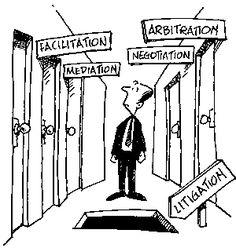
- Most of us have included fast-track equivalents to full-scale arbitration in contracts. An article, on this issue, holds that if the contract is sufficiently clear then such provisions must be upheld: www.cliffedekkerhofmeyr.com/export/sites/cdh/news/publications/2026/South-Africa/Dispute-Resolution/Downloads/Dispute-Resolution-Alert-17-February-2026.pdf
- The intricacies of labour law are really of passing interest to me, but the following was of interest: a contractor lost its service level agreement at a mine and was replaced by a new contractor, who proceeded to employ the employees of the outgoing contractor. The old contractor accepted that section 197 did not apply but wished to set aside the employees’ new contracts and have them declared its employees. The Labour Court would have none of this: https://dailyinvestor.com/business/122971/warning-for-employers-in-south-africa/
- An interesting question was recently posed of me: can one adopt a major person? Comment?
Hard News
- Trusts are often designed to continue beyond the lifetime of the founder. The problem with such continuance is that beneficiaries differ as to their needs and views of the future. The following case is instructive in this respect: https://www.saflii.org/za/cases/ZASCA/2026/23.html
- The following judgement is interesting, rather than of application to most of us, in that it deals with SARS having irregularly applied an anti-avoidance rule to a very expensive STC tax: https://www.saflii.org/za/cases/ZASCA/2026/22.html
- Much information on supposed corruption within the SAPS has been bandied around of late: this case illustrates the danger of making such allegations without understanding that an individual has a right to a reputation: https://www.saflii.org/za/cases/ZAKZDHC/2026/15.html
- This case is unusual, even in South Africa! The wrong dead baby was given to a mother who, on the discovery of the error, sued. In addition to the negligence of the hospital, the claimant had to prove detectable psychiatric injury: https://www.saflii.org/za/cases/ZANWHC/2026/40.html
- Prolixity in section 43 proceedings: https://www.saflii.org/za/cases/ZAGPHC/2008/334.html
- This judgement, against a TVET college, arising from injuries that led to the death of a student, owing to the lack of safety measures, is a timely warning to all institutions that they are responsible for the safety of those studying there: https://www.saflii.org/za/cases/ZAFSHC/2026/41.html
Conveyancing and Property
- SAMRA says that 23% of South African households rent their homes. 15% of South African households reside in apartments.
- Much of today’s new residential market is driven by what is termed lifestyle integration i.e. the ability to live, work and enjoy amenities within minutes travel of each other. For this reason, sales of lifestyle-focused properties are surging.
- Nedbank says that our property market outlook is positive but that this will be a gradual and uneven recovery, rather than a sharp rebound. Reinforcing this is statistics showing growth in retail sales up in the fourth quarter of last year.
- Public Works will flight a new entity i.e. the State Property Company, which will manage the development of office accommodation for government departments. As it is, the State owns 88,000 buildings and 5 million ha of land. Yet it spends R6m yearly on leasing private buildings while state-owned buildings stand empty. A lot of potential but, if one looks at the past, the turnaround will probably be slow!
- What appears to be a syndicated article but, which nevertheless is of interest and which relates to fines and the procedures to be followed by a homeowners association, is dealt with in the following article: https://www.tcinc.co.za/Our-Insights/ArticleDetail/Title/Drawing-a-line-on-fines
- Advtech will be developing a 10-hectare mega-campus in Durban.
- I could not but help wondering at a News24 article, on a developer having paid the owner of property which it wanted to develop R9.2m as a consultancy fee to defraud, apparently, the Fiscus. From the perspective of the purchaser, such fraud is understandable as it could avoid, potentially, transfer duty or VAT. From the perspective of the seller, income on which it would pay a minimum of 27% (income tax) as opposed to a maximum of some (CGT) 21.6%, this might be a questionable deal, unless there are tax credits which one is unaware. See also https://www.saflii.org/za/cases/ZAWCHC/2026/78.html
- If your tenant does not pay his rental, can you approach the Rental Housing Tribunal? Yes: take a look: https://madeleyn.co.za/2026/01/28/the-rental-housing-tribunal-the-unsung-hero-of-south-africas-rental-market/
- The High Court retained the power to appoint an administrator of a sectional scheme after the amendment to section 16 of the Sectional Titles Management act 2011: https://www.saflii.org/za/cases/ZAGPJHC/2026/171.html
- A claim for holding over is not for rental under the former lease, but for damages based on the market rental value of the premises, and which claim is illiquid: https://www.saflii.org/za/cases/ZAGPJHC/2026/172.html
- In the following case, our local municipality was given a ‘snotklap’ and, on reading the case, justifiably so, as it had settled but would not follow up on granting a rates certificate: https://www.saflii.org/za/cases/ZAKZPHC/2026/18.html
- Many conveyancers would have noted that the tracking system, allowing us to see where in the examination process a deed is, would not function as late. The reason for this is that the powers that be had limited the details available on our search engines without prior consultation with our profession.
- Are personal servitudes transferable? (West had drawn my attention to this case) www.saflii.org/za/cases/ZAWCHC/2011/317.pdf\
- Many of us buy land jointly; what to do when the relationship comes to an end: the actio communi dividundo applied: https://www.saflii.org/za/cases/ZAGPJHC/2026/175.html
Lighten Up
What is the difference between a mediator and a doctor? A doctor can kill his patients.